Stay Cool

Written for Chico Enterprise Record: North State Voices

Welcome to the tail end of the dog days. Sirius is just about finished rising with the sun, and, according to the ancient Romans, that means we’re just about finished with our hottest days of the year.  We can hope, but I’m not sure the summer heat will be quite done with us when the Dog Star moves on. What will indeed be over, however, is summer as defined by the local school calendar.

In a couple of weeks I’ll be teaching my students about those ancient Romans and other cultures from antiquity, and we’ll be reading and writing, and I’ll do my best to get some grammar instilled in them as well. It’s no small feat getting 12 year olds to think that what happened a gazillion years ago matters, and the key to their academic success is getting them to care. I have to say over the last few years it’s gotten harder, although I’m selfishly glad that it’s not just my take: across the nation, elementary school teachers and college professors alike are bemoaning a pervasive lack of engagement from their students. Everyone connected to education is trying to figure out how we got here and how to fix it.

Much blame is placed on Covid and the disruptions caused by the pandemic. The gaps in learning and the lost social opportunities indeed took their toll, and the trauma of losing loved ones can’t be overstated. (In California alone it is reported that there are 32,000 Covid orphans- children under 18 who lost one or both parents.) It’s readily understandable that performance in the classroom is impacted by that experience, but the fact is students were already struggling. 

In my experience and opinion, academic and even social participation has been in steady decline for about a decade, essentially coinciding with access to smartphones and the rise of social media. The entire world of information is just a Google search away, so toiling at a desk with a book– in pursuit of good standardized test scores– seems a tedious waste of time. Moreover, the instant gratification of dopamine hits from digital “likes” makes it that much harder to value the delayed gratification of conclusions drawn through thorough research and critical analysis.

It makes sense to point to Covid and technology as reasons for student apathy, but it’s not just disruptions and distractions that have derailed our kids. Perhaps even more consequential is the fact that they are growing up in uncertain times within a polarized environment. My sixth grade students were born into the aftermath of a deep recession, they have witnessed climatic destruction on a massive scale, they play in parks where ever increasing numbers of unhoused people live, and they have little confidence in their own ability to afford college or find a job that AI doesn’t take. They undergo yearly active shooter drills, they’re exposed to daily news reports broadcasting violence large and small, they see their own communities torn by social and political differences. These kids are trying to navigate their own trauma while learning to become adults in a highly polarized world. Is it any wonder that they check out?

Here’s the thing though: students might be checked-out, but they’re still showing up. Recent statistics released by the National Center for Education count the current high school dropout rate at 5.2%. For comparison, in 1960 the dropout rate was 27.2% 

Why are they coming to school if they aren’t going to participate? I think that they don’t know what else to do, and they’re hoping that somehow it all works out. 

It’s not that the kids don’t care. Far from it. It’s that they think that we don’t care enough about their futures to put aside our differences and work together to solve our  problems.

We’ve got big problems no doubt; they’re complex and not easily fixed.  We need to remember what we all have in common: we all want a roof over our heads and enough to eat, we want the people we love to be healthy, we want to feel safe, and we want to have the opportunity to be successful. Maybe if we start from there we can make progress together, because in addition to English and math, history and science, our kids need security, a sense of belonging, a reason to hope. And that has to come from the adults in the room.

So, I hope we can show them that it matters to us. They matter to us. As our community grapples with changes and challenges, I hope we can consider that our kids are watching and keep it civil. We may not have any control over the temperature outside, but we can turn down the heat in our own relations. And for the sake of the kids, I hope that productive collaboration in pursuit of a healthy future is in our stars.
Church vs Dirty Laundry

Written for Chico Enterprise Record: North State Voices

Is eavesdropping a sin, maybe akin to gossipping or lying? Does it make it worse if the person you listen in on is a priest? At least it was a benign conversation that I overheard at the farmer’s market Saturday. A man near me at the flower stall was discussing his sermon for Sunday, and I perked up because priests are interesting. When he said he was subbing at St. John’s Episcopal, I fully committed to the aforementioned possibly-a-sin.

St. John’s Episcopal is my church. Now, before you get the wrong impression, I can’t claim much religion. My relationship with faith is ambiguous; I used to teach at a Catholic school where my best teacher friend was Jewish and my paraprofessional partner Hindu; it all seemed equally plausible, and equally hard to hang my hat on. But I do love church as I know it.

I love the language of scriptures and hymns. I suspect my early understanding of the complexities of history, and my decently developed childhood vocabulary, came in good part from my weekly Sunday exposure to those words and lessons.

I love the tradition and ritual, the opportunity to show up on any given Sunday and have some idea, based on the liturgical calendar, as to what’s on the menu that morning. The repetition of the service allows me to go anywhere in the world and know what is happening in the mass.

I love the pomp and circumstance–how the priest slings incense on high holy days, and the candles play off the gold plate, and the choir promenades up the aisle with their voices raised in big spirit juxtaposed against sacred hush. 

I love the building: its high ceilings and wood with a wall of windows, the remembrance plaques on the backs of the pews, the organ in the choir loft,  the embroidered kneelers at the altar.

I love the fellowship. There isn’t another place I can think of where someone can belong without a single qualifying factor. No money? No problem. Casual or fancy, come on in. All identities in every iteration are respected. A person doesn’t even have to believe to be welcomed. 

I love it, but I hardly go there anymore. I can’t seem to figure out how to teach full-time, do the kid’s sports, keep the house clean, garden tended, family fed, (get the article written!) and get to church on Sunday too. 

I’ve friends who make it happen, but not many. Studies showing that church attendance is declining come as no surprise to those of us who have stopped going. It’s maybe less about a loss of religious affiliation than that church has become a casualty of our overbooked lifestyles. 

It’s too bad since churches like Saint John’s have long woven together people of different ilk through worship under the same roof. The loss of that common thread is more damning for the mundane elements of our experience than for the sacred. God will figure it out, but the fraying fabric of our community needs some mending.

At the market on Saturday I confessed to eavesdropping by introducing myself to the itinerant priest, bought my bouquet, and headed out with my arms full. As I approached the street, an unfortunate soul on a bicycle, clearly not living her best life, swerved around me. As she hit the curb in front of me, she fell over and lay prostrate in the street, bicycle and belongings scattered about her. Did I remember that I’d just spoken to a man of God? Did I put aside my things to help the poor and downtrodden as Jesus instructed? No I did not. Instead I took the Lord’s name in vain, turned my back, and walked away– every bit the Pharisee. 

I went to church the next day, where the priest from the market said it’s not humans who are good, it’s God who is good, and that’s what we’re supposed to trust in. Given my recent uncharitable behavior, it made me feel better. And although I’m too busy a sinner to have attended since, I’ll get there again. My faith may be somewhat doubtful, but I’ve no doubt that my church is good for me.

The Way I See It… (all lies and jest)

Written for Chico Enterprise Record: North State Voices

“Life is like a train of moods like a string of beads, and, as we pass through them, they prove to be many-coloured lenses which paint the world their own hue…” – Ralph Waldo Emerson 

When my daughter was young, my brother was famous for “cool uncle” gifts: talking robots, elaborate magical board games, and, one year, a medieval knight’s helmet. An interesting gift: it’s a full-size helmet complete with a moving visor and an opening neck plate. It’s made from sheet-metal, not iron and steel like the originals, but heavy enough. And anyone wearing it would definitely need an outfit of chain-mail underneath; the edges of the moving parts are wickedly sharp.

I’m not a medievalist, I had no idea what to do with that helmet, but my brother had given it to us so I wanted to keep it. Maybe I’d find a use for it someday. I didn’t, however, want my kid to cut herself on it, so I put it in the garage. Up on a shelf. Up on the highest shelf of a little-used cabinet built against a wall where a fire door slams a bit each time someone goes through it. I stashed the helmet there and forgot about it.

One day, months later, I was looking for our hand-held vacuum. I was grumpy– resentful because I was cleaning, and the vacuum wasn’t where it was supposed to be. My frustrated search led me to the garage where I opened up that little-used cabinet. Here, unbeknownst to me, the sharp, heavy metal helmet had been making its way to the edge of the shelf every time the fire door closed. When I opened the cabinet door, the helmet was primed to fall.

And fall it did, directly onto my unsuspecting, upturned face. Now remember, it was on the highest shelf, and so that full-sized man’s helmet gained velocity on its way to me. And remember those sharp moving parts? They opened when they met my face. Since shock prevents injury from being fully realized, I couldn’t readily determine how bad it was, but I knew it was bad.

My hands, instinctively covering my face on impact, felt wet. I was afraid to take them away and find blood or worse. My vision was blurry–was it because my glasses were lying broken on the garage floor, or had one of my eyes been gouged? I could make out the helmet splayed open next to my glasses. Was I bleeding from a jagged tear across my face? Would my nose be all there? I ran to the bathroom dreading what I would find.

I stood terrified at the mirror and peered through my fingers and… no gruesome monster looked back. Taking my hands away, I realized with intense relief that somehow no real damage had been done. Other than a swelling (but unbroken) nose, and watering eyes that would eventually turn slightly black, there was barely a scratch. 

Thank God, amazingly, I was alright. Thank God it hadn’t been my daughter or one of her grandparents or friends who’d opened that cabinet. What could have been disastrous was instead a minor accident, and thank God I still could clean the house instead of having to race to the hospital for emergency reconstructive surgery! 

The resentment I’d carried walking into the garage had literally been knocked out of me, and in its place came great gratitude. The rapid and complete change in my attitude, through such dramatic circumstances, seems to have created a lasting fundamental shift in my overall outlook. I’ve a lot more reason to be appreciative than I do to be grumpy, and I tend to remember that more often now. Turns out, that medieval helmet was pretty darn useful after all. Its fall made me see things differently (and when I chose my replacement glasses I chose a pair embodying the rosier tint of my proverbial lenses).

Of course I subsequently moved the helmet. It now lives in my classroom where I tell this story every year. It looks out of my office window into the middle school hallway; its presence asks us to maintain awareness of how we look at things and reminds us that sometimes a shift in perspective can make all the difference. 

Incidentally February is my brother’s birthday month, so here’s to you Brother. And to all of you. May your sharp edges rest easy, may your hearts be filled with gratitude, and may your lenses, whatever their hue, be clear.

Bylines

Written for Chico Enterprise Record: North State Voices

Dear Reader,

Please forgive the amateurish literary appropriation, but I’ve always wanted to write that, just as I’d always wanted to be a journalist when I grew up.  I’ve no illusions of aspiring to authored greatness, nor do I imagine that my contribution to the ER comes close to the labored dedication of folks who make newspapers happen. Nevertheless, this gig has been something of a dream come true for me; a gift of deadlines and bylines and my words on actual newsprint, so I hope you’ll bear with my indulgence in a column-in-review. 

My North State Voice debuted January 7th, with shocking images of an overrun Capitol and now-infamous headlines filling the front page.  I’d written about uneasy transitions without realizing the timing of my column, or the extent of the vitriol that would defile the hallmark of our democracy.  It’s an historically notorious keepsake edition indeed. Almost a year (and 13 columns) later, we’re finally starting to see some of the proverbial chickens coming home to roost. Hopefully such headlines don’t manifest again.

Of literal chickens the news is mixed. Since my writing on our backyard birds we’ve lost a few:  Patches decided to cross the road and unfortunately found a chicken-slaying dog on the other side, one of the Heathers keeled over after eating too many eggs, another Heather was taken by a possum.  I’m sorry about them, but the truth is everyone’s happier. No one is cannibalizing eggs, and the flock is more manageable now.   

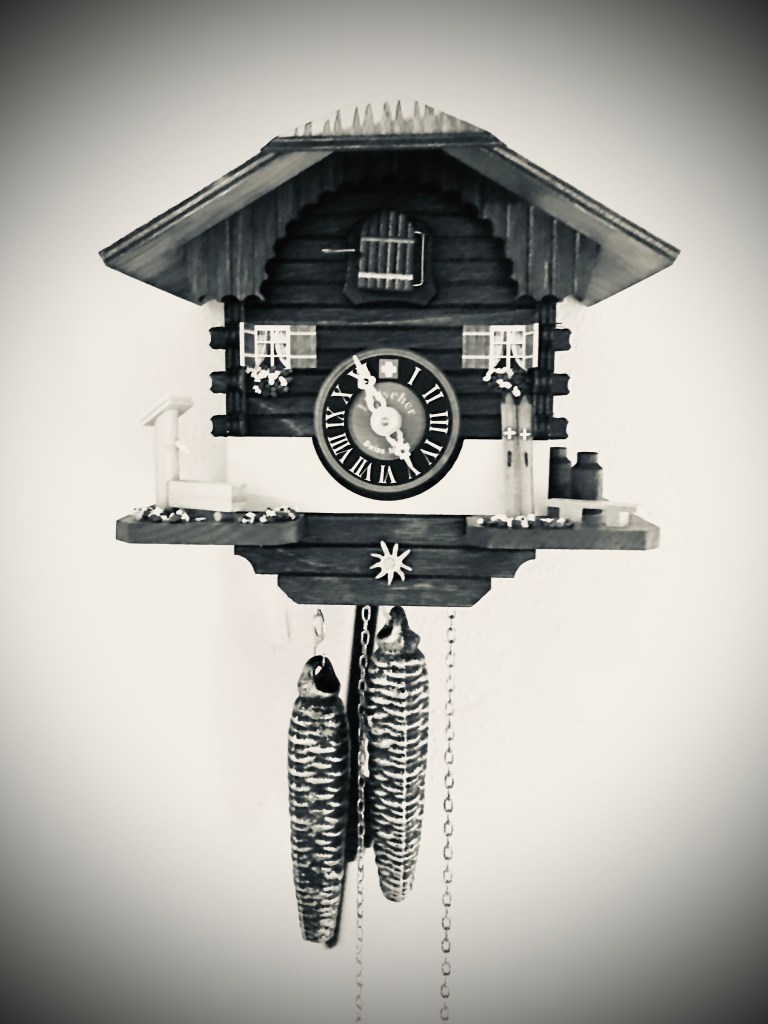
The cuckoo clock is in the shop; that silly bird stopped coming out on time.  It continues to represent my relationship with hours and minutes- vaccinated pandemic life has picked up considerably, and I’m again too booked to be reliably prompt.  So much for slowing down and savoring.  I insist, however, on my commitment to a Dickens a year.  Up next is Great Expectations; I’m told it’s both redeeming and short enough to manage while teaching full-time.

School is going well.  We’re still remembering how to interact with masses of other people all day, but junior high in-person is enormously preferable to the alternative.  And, Dear Reader, while you may be one who (strongly) disagrees- please hear me out.  It’s the masks that are keeping us together. I’ve had positive cases in my classes, and with social distancing and good ventilation essentially non-existent in my room, it’s definitely the masks preventing student-to-student transmission. I hate putting it on every morning, but I’ve learned from experience that masked teaching- while hard- is a lot easier than its virtual counterpart.

I’ve also learned (post-publication!) how to spell andesite, and that liquid amber is actually Liquidambar.  

That tree is trimmed, so there is less falling from it, and my tomatoes were quite successful this year.  I wish the same could be said for progress toward getting people off the street; between the airport fiasco, the chain linked ice rink, and the park full of tents, and despite those working tirelessly for individual dignities, it doesn’t appear that much positive difference was made. But what do I know? Maybe, hopefully, wheels are turning that will offer humane results.  

In other news, there is new high speed rail across treacherous terrain in China, my kid still talks-via video games-to the Tibetan friend she made while camping in the sequoias this summer, and did you see we humans actually wrapped those trees to keep them from burning? Our inability to achieve results is equaled only by our ability to achieve the impossible.

I wrote about some other stuff I love: swimming holes, and ancestors, and apple trees.  Looking back I’ve largely written variations on the themes of home and community.  Mostly I tried to gather and share things that matter to me, and it’s been incredibly gratifying to hear back from you that they matter to you too. There are thoughtful, lovely people all over this county.  Thank you, Dear Readers, for engaging with me.  It’s been an honor and a pleasure to write for you.

Bringing It Home

Written for Chico Enterprise Record: North State Voices

We purchased our house from the original inhabitants who grew up in it, and on moving in we found a gift and a note:  “Bread so you may never know hunger, salt so your lives will have flavor, and wine to bring you joy and prosperity. Good luck, this is a great old house.  It was full of love and laughs.”  It was a sweet gesture that instantly turned our new ‘house’ into a ‘home’. 

We are fortunate; we had the resources to buy a house and the wherewithal to turn it into a space reflective of that gift.  Home is not necessarily an easy accomplishment, and as a concept, it is a complicated place.  

Home can represent an achieved goal or a pipe-dream or a romanticized nostalgia.

If we invest in a home long enough, we make an impression there and feel bound by connection, but sometimes home is an in-between place we pass through inconsequentially without really leaving a mark.  

There are homes that house our firsts.  No matter how brief our stay, these places are distinct in our memory: the rooms of our earliest childhood, where we were when first on our own, where we lived when first in love. 

There are generational homes, where elders carefully navigate spaces they sped through in youth; where grandparents and greats resonate even after they are gone.  

There are spaces where home is shared with the intimacy of strangers on the other side of the wall, and then there are wilder addresses where acres outnumber square footage and trees are counted amongst one’s friends.

For those with privilege, home is often a sanctuary.  

For some, shelter must be made from canvas, or cardboard, or sometimes there’s only sidewalks and open sky. Once considered homeless, the terminology has shifted to ‘unsheltered’ or ‘houseless’ because home is so much more than simply a physical space. 

There are homes that are lost.  Three years ago today we were just beginning to grapple with the sudden destruction of our ridge communities.  Thousands of displaced people were on couches and in trailers and tents; the sky was black and choking with the ghosts of all that used to be. Many were waiting for news of their properties, those who knew they had lost everything were still in the shock that precedes grief, those discovering their places still standing were managing the juxtaposition of relief and guilt. 

People living here have experienced wide-spread traumatic loss before.  The Maidu tribes whose forebears called this place home for thousands of years, before Bidwell and Sutter and California statehood, know it well.  In the blink of a generation their ancestors lost their home and a great deal more because of government sanctioned atrocities committed in the name of greed and racism.

Our corner of the world has seen the ugly side of humanity, and we are daily living with the consequences of social and environmental degradation.  It’s time we reckoned fairly with our past and present so we can build a healthy future.  The truth is that each of us needs a place to be and to belong. As our community moves forward, I hope we can remember that common connection- and restructure from the better part of our human nature- with kindness, honesty, generosity, and compassion. It’s what this region needs and deserves.

And wherever you are reading this from, if it is in a home you’ve known for years or a temporary space, a new construction, a relocation, or a park bench under a November sky, I wish you luck.  I hope you are fed, I hope you are sustained, and I hope that you know love and joy today.

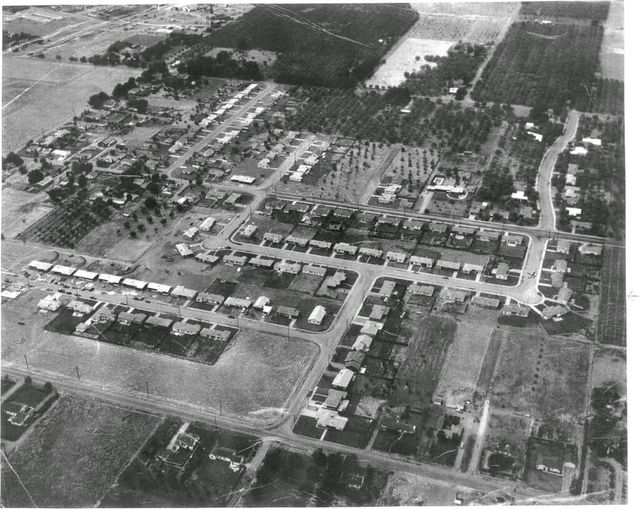
An aerial photo of our neighborhood circa 1950 something

Garden Apples

Written for Chico Enterprise Record: North State Voices

If you asked me what Paradise tastes like, I’d tell you it tastes like an apple.  Ironic since they say the apple is what got us kicked out of that garden in the first place, but to me it’s red dirt and pine trees, river water and Indian summer, all wrapped up in an afternoon snack. 

Michael Pollan’s The Botany of Desire posits that the apple, in pursuit of spreading its seed and multiplying, harnessed humans’ craving for sweetness and thus managed to propagate far from its Kazakhstan origins- becoming one of the world’s most popular fruits.  To my knowledge it’s the only fruit with a legendary personal champion.  

John Chapman- better known as Johnny Appleseed- headed west in front of the pioneers, planting apple trees that provided an opportunity to purchase a ready homestead claim as well as a reliable source of drink. Chapman’s trees didn’t typically produce eating apples; opposed to grafting, Chapman only planted seeds, and the sweet nature of the apple isn’t reliably “true” when grown from seed.  What his trees did offer was perhaps more valuable however: “spitters”, when fermented into cider, became an alcohol even the Puritans could tolerate. It was safer than water and undoubtedly helped soften the edges of pioneer life.

Chapman planted another sort of seed as he travelled; barefoot, barely clad, communing with plants and animals, he was a missionary for Swedenborgianism. His religion, based on the theology of Emanuel Swedenborg- Swedish scientist turned heretical mystic- included the ideas that the afterlife is a continuation of the progression of one’s earthly life, that at death love replaces space and time, and that all of nature is divine. Raising spirits in more ways than one, Chapman and his apples left an indelible mark on the American frontier.

He never made it out this far, but John Chapman captured imaginations in the West, and Johnny Appleseed Days date back to 1888- the earliest harvest festivals in California. Paradise started celebrating in 1937, and my first festival was in 1980- the year we moved to town.  I’d just turned nine and recall canvassing the square of booths at the recreation center, searching for kid-friendly fun and bemused by all the homespun and jam. It’s evolved since then, more booths offering more activities, even after the Camp Fire drawing a decent crowd.  It’s the apples. They attract people.  

My great-great-uncle planted three trees on his three acres in Paradise. Two of those trees still stand, covered in climbing roses, wide hollow trunks ringed with woodpecker holes.  My Far-far (Swedish grandfather) planted two more, a “Double Delicious” that I never knew, and a “Yellow Transparent” whose memory I still chase. It was the perfect apple tree. Strong branches grew low enough to offer purchase to a climbing kid, and its green-gold fruit: sweet, crisp, and soft-ball sized, was reliably devoid of worms.  I spent many happy childhood days perched on a branch, book in one hand, apple in the other.  Sometime in between childhood and now, that tree died, and my father planted an orchard with apples.  The Camp Fire burned its edges, but it survived, and there’s a bowl of its fruit on my kitchen counter as I type.

Henry David Thoreau begins his essay “Wild Apples” saying, “It is remarkable how closely the history of the apple-tree is connected with that of man.” His discourse on that connection, from ancient mythology to modern grafting, ends with the lament that, “The era of the Wild Apple will soon be past.” Thoreau was right; between industrialized agriculture and the winnowing of wild spaces there isn’t much room for a random apple sprout. There is, however, hope in the timeless inspiration of a man who wanders and plants and preaches love. There is devotion in the generational drive to plant apple trees in one’s own plot.  Pollan’s apple may have hitched its fate to ours in order to move beyond its original forests, but that fruitful ploy is, by chance or by design, ultimately helping us find our way (back) into the garden. 

A Great-Great-Uncle Gus original apple

Juggling Apocalypse

Written for Chico Enterprise Record: North State Voices

A friend recently posted that she was “juggling multiple apocalypses”, and for many of us, I think, there is this sense of futility and frustration with engaging in the world as we knew it, even as it may be ending, so the show can go on.  We are back at work and school and play while fires rage and watersheds die, social bonds fray and violence is committed, hospitals fill with disease… and that is just here in our neck of the woods- nevermind all that is happening across the country and the globe.  What a time to be alive.

While managing the estate of my late aunt several years ago, I found full suitcases in most of the rooms in her house.  She lived in Oroville and likely put them together during the spillway crisis in 2017.  She packed in preparation or in fear, or maybe both, but one would never see the latter in her. Through that potential disaster, and the fire that burned her hometown, and even in her illness at the end, she was unruffled and composed; her quiet dignity fully intact.  

I kept one of those suitcases: a 1940’s hard-board traveling case with a tweed veneer, so old and fragile it houses just my newspaper columns, though it hardly seems capable of carrying a person’s life even in its heyday.  It was my great-grandmother’s; a woman I know only from the grainy black and white and unsmiling pictures typical of her generation. Also typical of her generation: she was a teenage immigrant, lived through two world wars, the Spanish Flu and the Great Depression.  There were personal tragedies as well, and probably not that much to smile about. I’m told however, that while she was stoic, she was always kind, gentle and fair; her strength of character ironclad.

The frying pan I inherited from my aunt’s kitchen was my grandma’s. It’s heavy and unwieldy. There is no artifice in a cast iron pan, and its character comes from layers of seasoning.  It can last for ages, and my familial generations are linked through nourishment cooked up in that pan.  My grandma died when I was young, and my knowledge of her is also mostly from photographs- although unlike those of her mother, in all of them my grandma is smiling.  There were hardships of course, but probably the world seemed a little kinder, certainly photography became more relaxed, and my grandma’s generation found it possible to turn a smiling face to the camera.  

I learned to juggle in 6th grade. It was a difficult year for me; I was far too uncool for school, but somehow I learned to keep balls in the air then.  There’s a picture of me from those years ago: I’m in the midst of juggling and unaware of the photographer.  I’ve got acne, a terrible haircut, and a grin on my face. The trick I’d learned was to stay in control and do it all with a smile- because that’s what people focus on.

I appreciate that smiles come more readily now than they did generations ago, but those expressions are only worth the quality of the character behind them, and the future may require a great deal more of us than we had expected. ‘Apocalypse’ evolved from the Greek word apokálypsis, essentially meaning to uncover or reveal. Maybe these times have come to remind us of what matters, to show us a better way by teaching us which balls to keep tossing and what to let drop.  It’s not the show that needs to go on.  It’s our common decency and our kindness- even in the face of destruction and disaster- that we need to commit to.  That’s what will keep us going, that’s what is worth packing and carrying, and that’s what our children will remember.

Back to School

Written for Chico Enterprise Record: North State Voices

I’m having back-to-school dreams.  They come yearly around this time, usually in the form of running late… involved in some dream thing I’ll suddenly realize, “OMG there’s a classroom of unsupervised tweens I’ve got to get to NOW!” With twenty-plus teaching years under my belt I’m  confident in doing what I do, and I’m always more excited than I am nervous, but I still get the pre-show jitters. Teaching is akin to putting on an interactive performance all day every day, and in the beginning it’s with a roomful of participants that I haven’t yet met.  It’s nerve-wracking, and thrilling.   

In the current environment I’m edgier than usual worrying about the future, but I can’t wait to be in the classroom with my students.  I love their fresh perspectives on literature and history, the opportunities to nurture passion for the spoken and written word, the vital work of direct instruction in critical thinking.  I’m particularly excited to share insights on writing processes that I’ve gleaned through this column.  Besides, I sat on my duff so much last year.  Tethered to the computer from 7:30-3:30 everyday my body, used to easily getting my 10k steps via the constant of the classroom, is still protesting that abrupt sedentary shift.  

I come from educators. My mom spent evenings prepping lessons and materials to work magic with her third-graders in Thermalito, and my dad spent weekends grading blue books from his Chico State history students. Both my aunt and my husband’s grandfather were highly regarded teachers in Oroville.  My grandmother was secretary at Paradise High School and my husband’s grandmother president of the Bird Street PTA. So that ugly quip referencing teachers as those who “can’t do” is more than a little personal.  My parents may be the most capable and dedicated people I know.  My aunt’s resume includes volunteer stints as an archaeologist in the Middle East; my grandfather-in-law, an officer in the US Army Engineers, served in key command positions during the Berlin Airlift in the 40s. These are accomplished people who cared enough to invest their lives in education.  

Derision and even open hostility towards educators is surfacing these days. Issues have become polarizing, and teachers are easy targets.  Perhaps it’s because there is a lot of misinformation out there; if you hear something that concerns you, maybe connect with a credible source- someone with direct knowledge about your concern- before taking it at face value.  Then too, we all have personal stories of “bad” teachers.  In high school a math teacher I didn’t understand terrified me, and so I didn’t ask questions and failed his class.  My mom still holds it against him.  He wasn’t a good fit for me, but many boys who didn’t otherwise like school adored him. It’s impossible to be all things to all people though teaching is a profession demanding exactly that, and in all my years I’ve rarely met a teacher that didn’t try.  Were they tired?  Absolutely.  Overwhelmed?  Sure.  Some better than others?  Of course.  But they all worked hard and they all cared.  

As we head into this new year, I hope folks give the people at school some grace.  There is definitely a lot of angst, and the bad taste from last year lingers.  Our community is going through so much, and we owe it to our children to rise above the issues we have.  Let’s treat each other with decency even if, especially if, we don’t agree.  By the time you read this school will be in session.  We teachers will have a sense of the dynamics of our class, and we’ll be adjusting our dreams and plans to meet the specific needs of our students in this uncertain time.  One thing is certain, and I know I speak for my colleagues too, we are ready to work our duffs off for those kids.  Whatever that may look like this year.

I really appreciate this picture circulating on social media right now.

Moving with Grace

Written for Chico Enterprise Record: North State Voices

We camped last week in Sequoia National Park; it’s typically hot there this time of year, and by the time the sun was up for an hour we were looking for respite from its rays. We traversed the section of Kaweah River that runs through the campground, however back-to-back seasons without melting snowpacks have left the creeks depressingly low. Our quest repeatedly offered up only skeletal remains of swimming holes, but eventually we did find a sweet spot still deep enough to dunk, and we spent much of our time there.  As it was the only decent place to cool off, all the other campers were there too, and my daughter befriended a girl from a neighboring site.  In the way that children’s friendships do, they brought our families together, and in our communal space we traded food and swapped stories.  Our neighbors were Tibetan and the grandmother, Tenzin, shared how she fled to Nepal – escaping cultural and economic repression – when the Chinese occupied Tibet in 1950. She immigrated to the US with her adult children in the 90s.

Last month I wrote curriculum for a digitized tour of Angel Island, a place often referred to as the Ellis Island of the West.  Immigrants sailing across the Pacific were detained there between 1910 and 1940, and I’ve read dozens of their testimonies.  For context I’ve also read more current stories from Central and South America and the Middle East.  Common threads in these personal histories illustrate the deep impacts of immigration- particularly the difficulty surrounding the choice to move, in desperation or hope, leaving behind everything one has ever known.

As a child I loved the Little House on the Prairie series by Laura Ingalls Wilder-the pioneer girl who fictionalized the experiences of her family leaving Wisconsin to head West in the 1870s.   My father read the books to me, and of course I related most to Laura and her thrill of exploration as the family migrated across the states and territories looking for a place to land. In reading the books aloud to my own daughter, my sensibilities re-aligned with Ma, uprooting herself and her children time and again in pursuit of a better life.  I cannot imagine the strength that must have taken.

My own people came here from various parts of Europe, mostly in the late 1800s and largely for economic opportunity.  I appreciate those journeys that granted me birth in the US- in many ways a ticket to personal freedom and plentiful resources- and while I love to travel, I’ve always been glad to come home to Butte County.  Immigration- even migration- isn’t part of a reality I’ve seriously considered.  Now however, sometimes, I wonder.  Our waterways are parched, the ridge is burning again, and social tensions feel as heated and toxic as the air outside.  I worry for the future here- in Chico and in the US.  It doesn’t look or feel like the same place I grew up; it’s not where I’d expected to raise my child.  

I suppose, though, that it’s often the case that circumstances don’t meet expectations, and somehow we adjust and carry on.  Tenzin deeply misses a home she’ll never return to, and yet she speaks of it with a warm and easy smile.  Ma and Pa Ingalls built and moved, and built and moved, enough to write nine books about it- and Ma’s familiar refrain was, “All’s well that ends well”.  My great-great Uncle Gus, a Swedish immigrant, single-handedly cleared a stoney forty acres on Neal Road in the 1920s and then had to sell off most of it when the irrigation district levied a per-acre water tax in the 30s. Despite all the work in vain, my uncle was never bitter.  I’m reminded to take heed of the grace of perspective, and count my blessings.  Nowhere on earth is free from social or environmental concerns, and I’m lucky to live in a time and place where it’s possible to hug both a giant sequoia and a Tibetan grandmother on the same day.  Those are gifts to be grateful for indeed.

Railroad Ramblings

Written for Chico Enterprise Record: North State Voices

Most of the music in the background of my childhood was classical; my parents weren’t into the funk and disco of the time, but my mom did like folk music, and her Peter, Paul and Mary records were regularly featured on the turntable. Their train covers were my favorites- freight trains going so fast, trains bound for glory, trains 500 miles gone.  Train inspired songs abound in Americana; possibly the most famous, “I’ve Been Working on the Railroad”, has no known author and a number of iterations since its official publication in 1894.

My father-in-law started working for the railroad as a brakeman on Western Pacific in 1966, and retired as a conductor on Union Pacific in 2008. Besides the scenery, working with his crew was the best part of his railroading. Together they ran the trains along the Main Line and the North Line, moving freight through the Central Valley. He tells how back in the day his step-dad, also a railroader, would sometimes pay the hobos camping by the tracks a quarter for a cup of their “rainbow stew”.  The recipe was variable, but the men were consistently friendly and willing to share.  People have always lived next to the tracks: Chinese camping alongside the lines they were building,  Depression-era boxcar jumpers catching rides to rumors of work, today’s unsheltered seeking a place to be.

In college there was a party house next to the tracks. Memories of nights there are starlit and lantern hung, live music jamming and masses of twenty-somethings howling with the train as it shook the ground under us- feeding our heady excitement and sense of freedom.  My largely silent black lab also howls when he hears the train whistling.  He doesn’t otherwise use his voice, but the whistle calls to him, arousing some latent desire to join the roaming pack.

The train is like that- it makes us want to jump on and go with.  My dad tells how as a boy, if he ran fast enough up the ridge when he heard the whistle coming up Skyway, he’d get to the top in time to watch the train rumble by. I’m old enough to remember the tracks as they ran through Paradise; rusted iron the same color as the dirt with weeds growing through the redwood ties.  Later, when the rails were pulled for the iron, the ties remained until people took them for personal use, and then it was just the dirt connecting one place to another- after a time paved into bike paths.  

In the US we haven’t committed to rail as public transit in the way some other places have- perhaps because of our identity of staunch independence.  In my experience trains reflect the personalities of their countries: I’ve ridden sleek, non-stop bullet trains in Germany,  taken a lovely, meandering ride (with open windows!) down the coast of southern France, waited for hours for a late train in Italy, ventured into the middle of nowhere in Sweden on a contraption that was called a train but looked more like a bus with bike pedals, sat shoulder-to-shoulder on the crowded floor of a post-communist Eastern European version.  

I don’t know the railroad history of other places, but as with so much else, construction of the American railroad includes an ugly legacy of destruction of Indigenous lands and exploitation of migrant labor.  This isn’t really about the American railroad though.  It’s about connecting- like the interlocking wooden train tracks my little brother would wind through the living room of our childhood home, and the network of alleys left where actual train tracks used to run through our hometown.  It’s about association: “ties” and “couplings”, “unions” and “conductors”. It’s about belonging, from the viscerally stirring call and response evoked by train whistles, to rail-side communal living. It’s about the ultimate purpose of transcontinental railroads-bridging the distances between people-bringing us together.  And that’s something worth singing about.

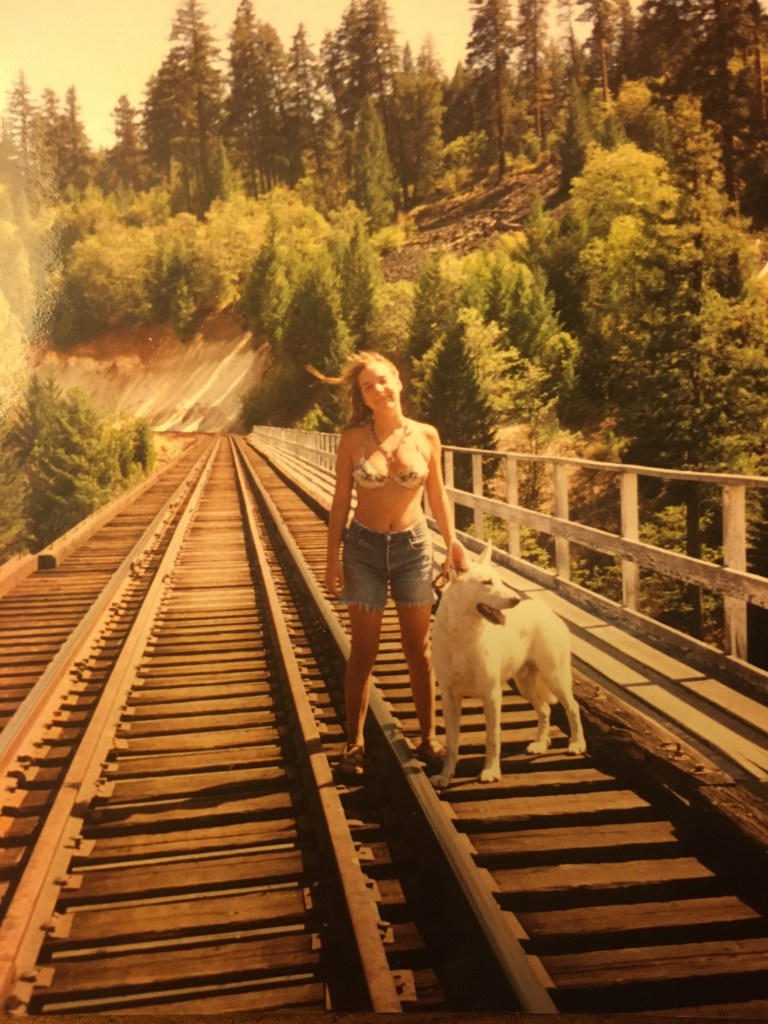
The “Stand By Me” Trestle- 1990’s

The Flumes Revisited

Written for Chico Enterprise Record: North State Voices

The weatherman says triple-digit temperatures are in store for us next week, which means that folks around here will be looking for good places to swim.  Plentiful options are one of the things that (used to) make this region so special.  My grandfather swam at Nelson’s Bar, on the West Branch of the Feather River, in the time when men wore woolen bathing suits that covered their torsos.  My dad and aunts and cousins swam there too- locals of their generation fill Facebook’s “You Know You’re From Paradise When…” with reminiscences of sandy beaches, towering rocks and a swimming hole deep enough to dive into from Nelson’s Bridge.  In the sixties Oroville Dam was built, and with that Nelson’s Bar was submerged and was no more.

Nelson’s Bar circa 1960- Photo credit John Doyle

I spent the summers of my youth on Butte Creek, blissfully jumping off rocks into crystalline green water, reading and journaling sprawled on my favorite sandy beach, gorging on fat sun-warmed blackberries and spying on enormous salmon in shady pools, marveling at sacred nature in between canyon walls.  In the nineties the population in that canyon swelled; people built houses and fenced their properties.  The powers that be posted No Parking signs, and the public now squeezes into a couple of sanctioned spaces.  The sandy beach where I spent so many days is long gone.

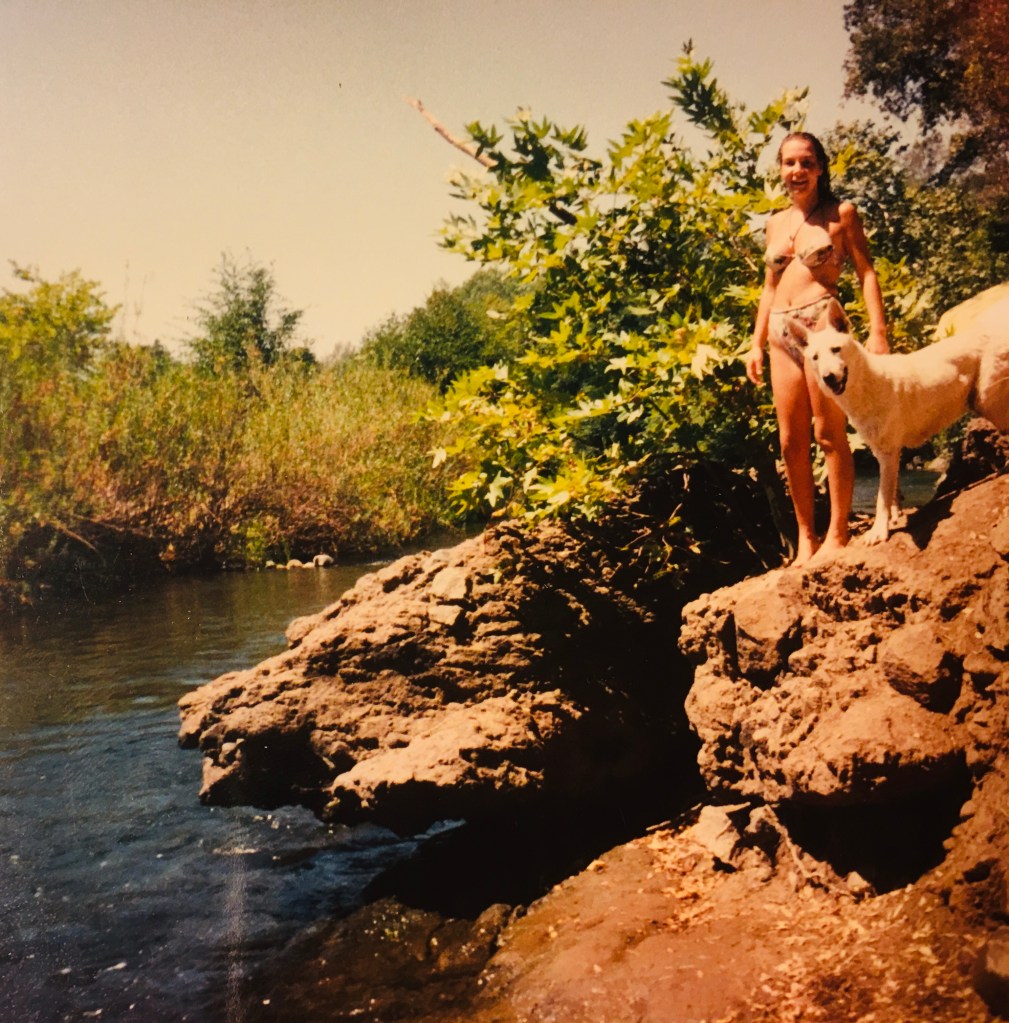
Butte Creek circa 1990

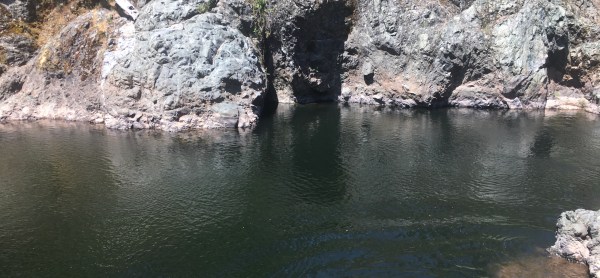
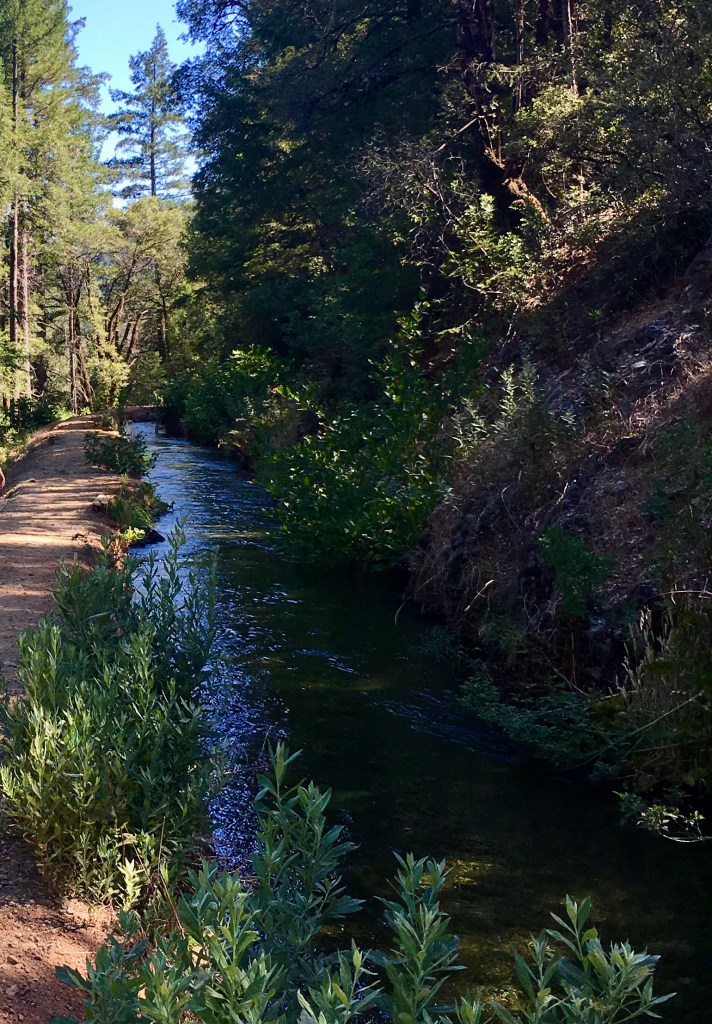
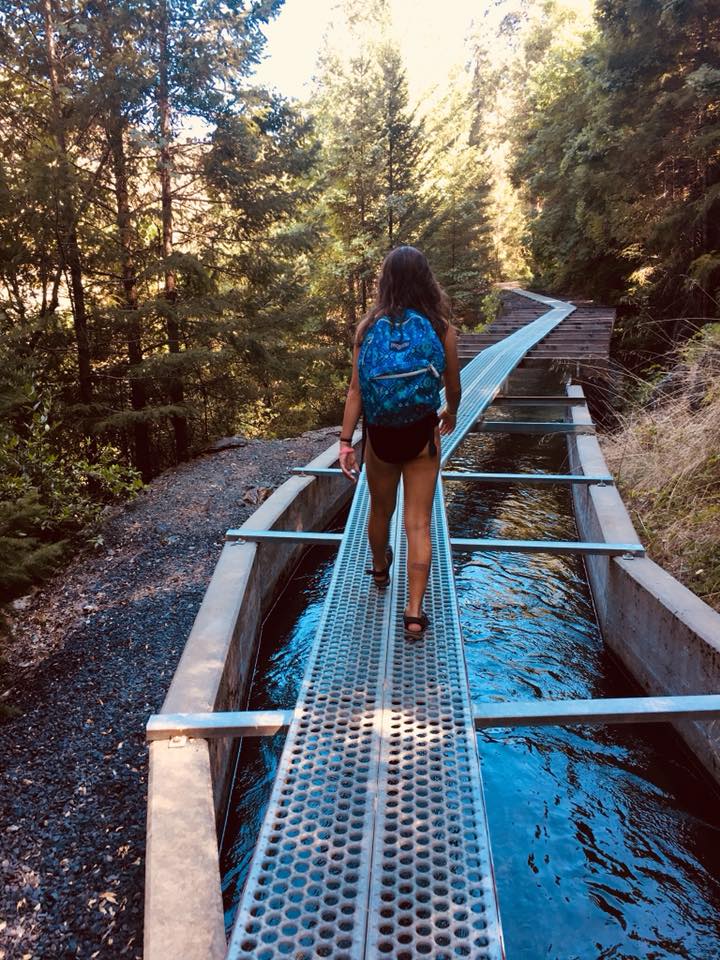
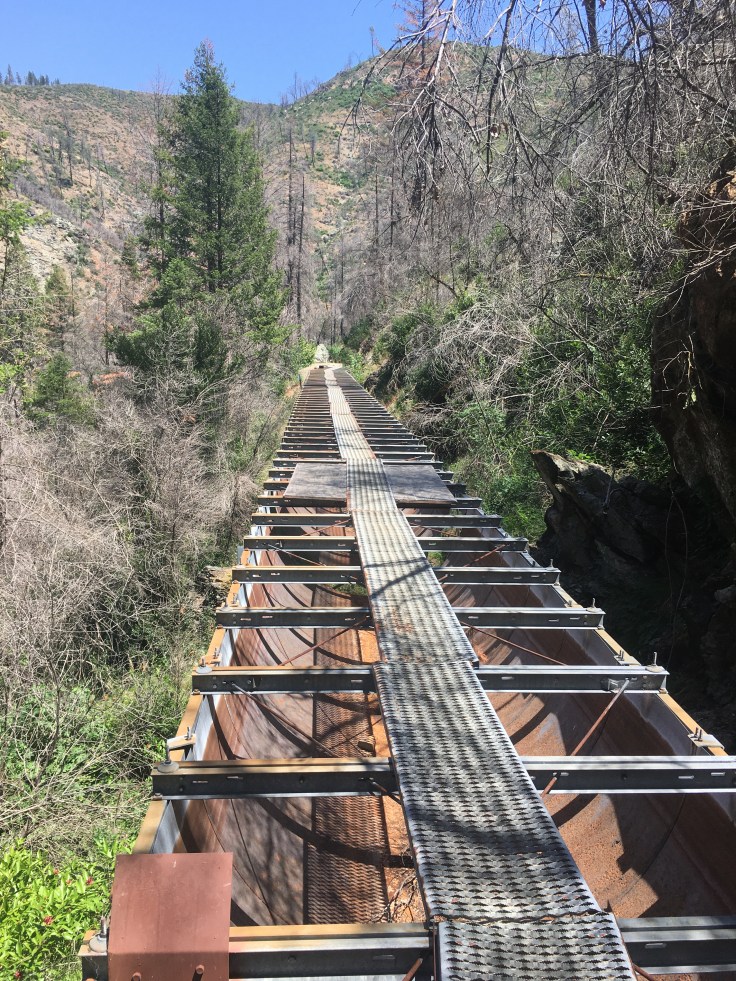
While I loved Butte Creek, as kids we were always exploring for other excellent swimming holes.  Some of those places are still around, and some of the best are in Upper Park where public access is protected by the Bidwell’s vision.  There is still good swimming to be had on the West Branch too, especially via the flumes off Dean Road.  Before the Camp Fire the flumes ran with water, and while nerves needed managing in order to brave the catwalks, the grade was gentle and the hike mostly shaded.  The post-fire flumes are dry, some of the catwalks are gone, and there is a lot more sun, but I’ve found I can still scramble to my favorite spot there. 

Flowing flumes Summer 2018
Dry flumes post Camp Fire
(May 2021)

While not exactly a secret spot, I’d still rather leave it a little lonely and not call attention to the flumes.  I’m driven to write about it, however, because public access may well depend on public pressure.  Rumor has it that PG&E is trying to offload the flumes to a water delivery agency.  Water is valuable; it’s not a stretch to think private investors might block access.  A gated chain link fence now crosses the old PG&E gate- denying public passage is as easy as locking that chain link.  What if we could preemptively somehow compel the entity responsible for the destruction of the region to aid in the regeneration of the community by way of guaranteed public access to the flumes?  If such was granted in reparation, the town could potentially even capitalize on the site: paid and secure parking, a bait and tackle shop, guided tours, all possible options creating local jobs and recreational revenue while achieving a Bidwellesque vision of protecting access to historic beauty.

May 2021

The summer before the Camp Fire, cousins from Maryland stayed with us as part of a cross-country tour.  One of their priorities was to “visit awesome swimming holes”.  I took them to the flumes to spend the day at the river.  A month or so later, after they’d returned home, they reported back that swimming at the flumes was the best swimming in the entire country.  What a shame to let that go the way of Nelson’s Bar or Butte Creek Canyon.  Future generations ask us to stand in the face of infrastructure and privatization and insist on the compelling right of public access to the flumes off Dean Road.  I pray we can continue to enjoy that particular slice of heaven in Paradise, and not just remember how it used to be.

Rock jumping with cousins- Summer 2018

Gary’s Story

Written for Chico Enterprise Record: North State Voices

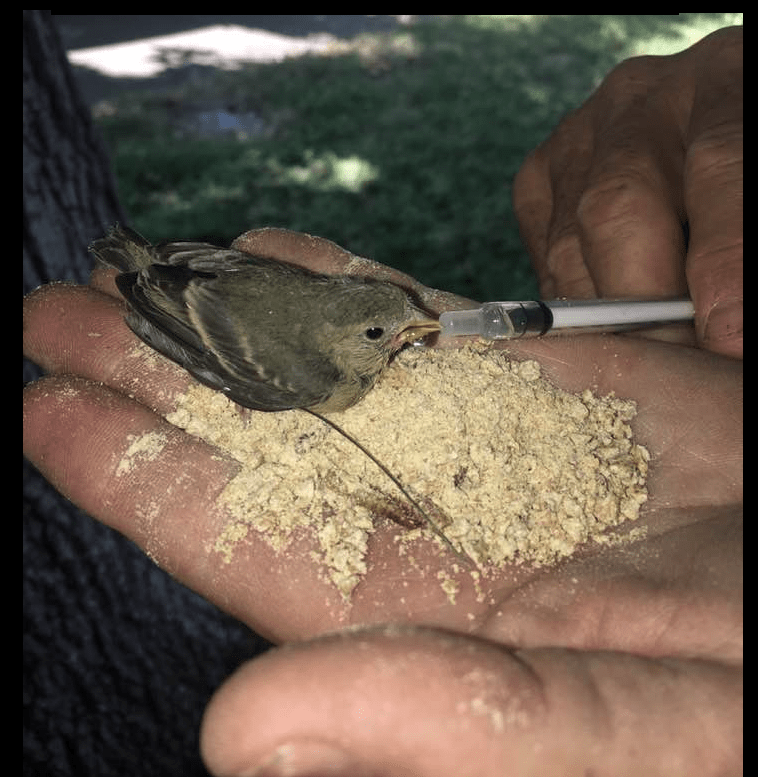
Something’s usually falling from the Liquid Amber in our yard: leaves, pollen, prickle balls… and recently a baby finch my family named Gary. Bright yellow and smaller than my thumb, Gary caught my eye when he landed on the lawn and flailed about, apparently too young to fly. Google advised we “rehab a finch” by placing him in a box affixed to the tree. That done, we waited and watched. Sure enough Mama Finch came buzzing around, but Gary didn’t leave his box. By sundown Mama had disappeared, and Gary hadn’t moved. Afraid he wouldn’t survive the night we brought him in; by morning he was flying around the kitchen. We didn’t know if he would make it on his own, but as a flying bird should fly outside, we got him out the door.  He landed in a camellia, started chirping, and thus began the community rescue of Gary.

We couldn’t see him, but we could hear him.  Movement in the camellia produced a bird; but to our surprise it was a titmouse. It flew to a nearby bush, perhaps hoping to avoid any drama, but Gary emerged and followed, landing next to the titmouse.  They sat shoulder to shoulder, the baby finch a quarter the size of the titmouse. Gary continued to chirp, relaying his plight.  When he eventually stopped the titmouse flew off, and Gary, now quiet, remained behind.

The titmouse, seemingly accepting the responsibility of helping Gary, flew to a nearby sunflower, faced south, and called for several minutes.  Next it went to a cedar, faced north and continued calling until a crow arrived and lit on top of the tree. Then the finch took off to the south, still calling.  

Gary stayed perched silently in the bush. The crow began to caw loudly, keeping at it for an extraordinary amount of time. At one point during the crow’s tenure a bluejay came around, making fun of the situation; the crow scolded it and sent it on its way. Gary still didn’t move. Time went on. The sun was getting low. The crow took off, Mama hadn’t shown up, and the titmouse hadn’t returned. We decided to bring Gary in as it didn’t seem he was leaving. We corralled him back into his box and inside.

We’d been too impatient. Minutes later Mama Finch was flying around the garden, so we slid Gary’s box out the door. Mama started buzzing the box and calling, and Gary started chirping again, but he still wouldn’t leave the box. Mama tried and tried; Gary wouldn’t budge. Eventually, exasperated, Mama took off. Hoping for a second chance with a better outcome, we slid Gary out of the box.

Time passed. Gary stood, exposed and chirping in the garden, and we feared we’d scared Mama away for good.  Suddenly a hummingbird appeared on a flower just above Gary. After a moment it took off and returned within seconds, flying fast, two brown sparrows in formation on either side. The three flew directly to Gary.  The hummingbird went on to feed, while the sparrows sat on a stalk above Gary and looked around. They stayed for several minutes; once assured that all was safe they fluttered up, chest-bumped, and flew off. Immediately Mama Finch was back. She landed on the garden fence and called. Gary finally flew up to her. They rubbed shoulders and then together flew off into the sunset.

Speculation on avian sentiment aside, every bit of bird behavior in Gary’s adventure is true. We humans are like those birds: some of us are helpful titmice, some focused hummingbirds, some crows in charge; some of us are worried mothers doing all we can, or lost baby finches, or chest-bumping bros.  And yes, some of us are bluejays. Perhaps it’s human projection and conjecture to think the birds worked together to reunite Gary with his mom, but I believe it to be so.  I also believe that, if like those birds and despite our differences we work together on the things that matter to us all, we’ll find the connections we make are stronger than what divides us.  Maybe then we can create our own happy endings.

Gary in Ronnie’s hand -that’s chicken feed there too. Thankfully the bird didn’t eat any of it as we later learned it expands and can be deadly to small birds.

Taking Stock

Written for Chico Enterprise Record: North State Voices

The wall clock read 9:52 for months.  It typically told us when to finish breakfast so as to get to school on time, and when to finish dinner so Dad wouldn’t be late for choir practice.  With school an eat breakfast while zooming affair, choir practice cancelled, and no one coming for dinner, I didn’t bother resetting the clock.  I’ve always resented the get somewhere, be somewhere, constant reminder; leaving it frozen perhaps my way of defying that imposition.

Marking and measuring- what there is of our days: what’s gone, what’s gained- humans have taken stock since literally the beginning of time.  Lunar cycles were carved on bones and cave walls some 30,000 years ago; for 6,000 years we’ve measured hours and calendared months- systemic time created initially and primarily to organize food. 

When I was young my parents made sure we sat down to dinner nightly at 6:00;  I’ve struggled to replicate that in my own iteration of domestic life.  I feel guilty about it, but when everyone works late, and with all the extracurriculars, it’s easier to take-out.  This year- nothing but time, homegrown veggies, and too many eggs on my hands- I found my inner cook.  She’s not half-bad and a lot less expensive.  We still aren’t great about sitting down around the table, but as my daughter pointed out we aren’t exactly lacking in family time lately.  

Usually bustling with school, activities and friends, my tween has been forced instead to hang out with her mom.  Oh my goodness, what a gift these hours and days and months of proximity.  I’m discovering who my child is as she moves into adolescence, and for better and worse, who I am as the mother of a new teenager.  I am selfishly grateful for this stolen year with her.

She and I read A Christmas Carol over the holidays, and in that classic Dickens writes, “It is a fair, even-handed, noble adjustment of things, that while there is infection in disease and sorrow, there is nothing in the world so irresistibly contagious as laughter and good-humor.”  Needing more of such timely elucidation, I pulled A Tale of Two Cities off the shelf.  I was rewarded with the reverie on Monsignor during the French Revolution- it’s devastatingly current.  Dickens is rich, requiring time to digest.  My father recommends one a year; sound advice I’ll follow.

With family visits moved outside, we’ve spent months following Dad around the side streets and backroads of Paradise.  Past caution tape and beyond no trespassing signs, we’re exploring the town where he and I both grew up.  Time is layered there, viewed through the kaleidoscopic lens of childhood memories from the 1950’s and 80’s, overlain with ashen Campfire trauma, and the future rising with the daffodils as construction builds out of the scars.  

There seems to be a springtime shifting now.  Maybe the not-too-distant future holds again the need to know when to finish things up and get to things.  Deciding I’d best reset the clock, I found I’d left it too long unattended, and the back had rusted out.  Thinking of replacing it with something modern, I visited The Watchman, and came home with a cuckoo clock instead.  A playful piece, painstakingly hand-carved and operated entirely by gear mechanisms, it reminds me that time is better viewed, not as a utilitarian necessity, but as a treasure to enjoy. Stop and listen, it says. Don’t rush, it says.  Linger over good food, read meaningful books, take walks and talk, learn about the people you love.  Spend your precious time wisely, it says.

The Inner World of Backyard Chickens

Written for Chico Enterprise Record: North State Voices

Last March, when everyone started wiping down groceries and toilet paper was scarce, someone in my family worried that society might fail and decided it was time to try a little homesteading. The vegetable garden was planted, well beyond its usual boxes and with more variety: swiss chard, corn, even a pumpkin made it into the ground.  The Costco-sized bag of flour was purchased. And the chicken coop was built.

Our favorite feed store had Brahmas and Leghorns the day we picked up chicks, and someone in my family decided the right number was four of each. So eight chicks were raised in a brooder in the garage.  Unfortunately one of them was extinguished by our overly curious dog, so someone in my family decided to get three more.  Final count: ten chickens.  Four Brahmas, three Leghorns, two Barred Rocks, and an Ameraucana named Olive.

Three of the Brahmas are called Heather.  Please excuse the pop culture reference, but Gen Xers understand.  If vanity were a chicken, she would be a Brahma named Heather.  Enormous  things, they are very proud of themselves and play a fierce social game.  In keeping with the movie theme, we named the fourth Brahma Smalls.  It’s only somewhat ironic as she is the odd girl out.  Poor thing has feelings as big as she is, and she needs much attention when those feelings get hurt.  

The Leghorns don’t seem to have feelings or a social game.  Spicy and Sparky are indistinguishable, but Patches stands out because she flips her head to look at the world upside down.  Or perhaps it is to get her comb out of her eyes.  Leghorns, their fleshy red crests flopping to one side, are jumpy and skittish- maybe because that comb is always bouncing around in their peripheral vision.

The Barred Rocks are known collectively as Dobbydots.  Almost as big as the Brahmas, but less socially aggressive, they come running when they hear our step and maintain a conversational clucking as they follow us about.  The Leghorns aren’t a bit interested in us, the Brahmas only when there is something in it for them, but the Barred Rocks are engaging creatures.

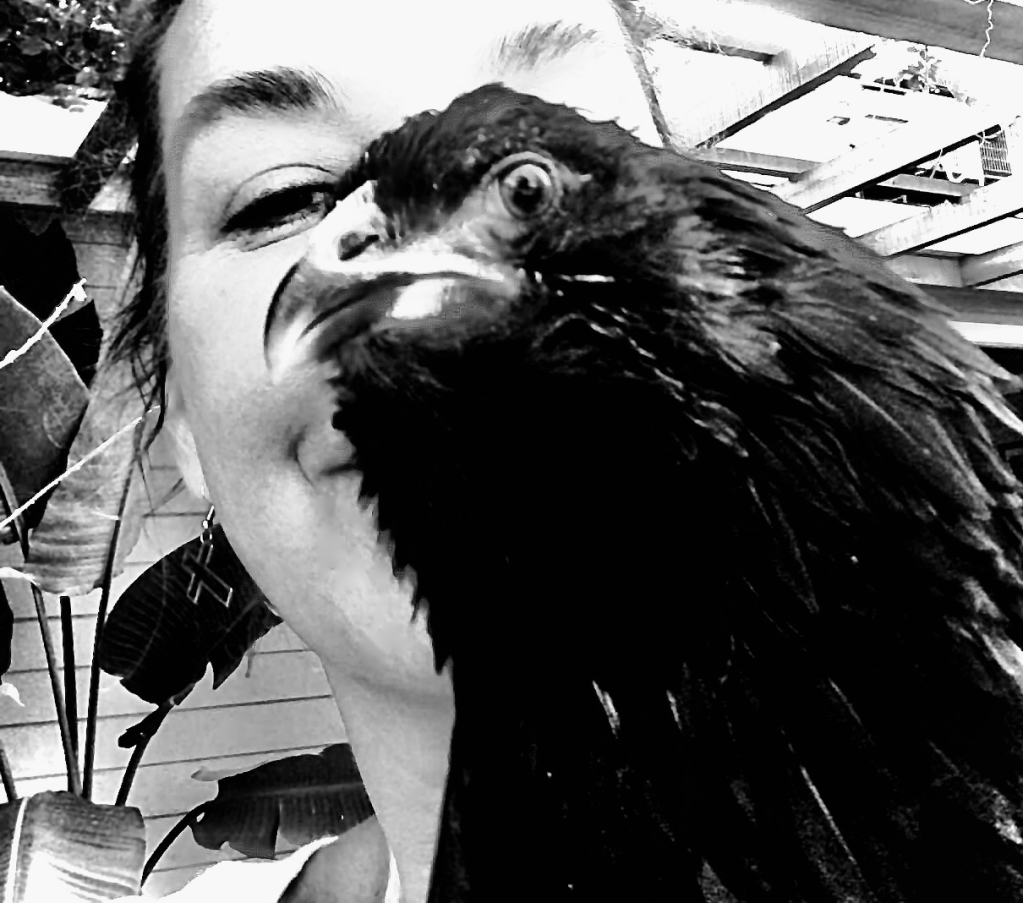
Then there is Olive.  A different sort of bird, and full of personality, she’s managed to capture our hearts.  The sky often seems to be falling for Olive, and she consequently frequently freaks out.  She has zero spatial awareness: she launches herself in the general direction of where she wants to go, creating chaos as she accidentally lands in the path of, or even directly on top of, her startled coopmates.  While clueless about chickening, Olive seems keenly aware of worldly happenings.  She daily flies the coop, spending time foraging on her own.  She tries to get our (now indifferent) dog to recognize her, running next to him as he scouts the perimeter of the yard. She goes to the gate to greet visitors.  She begs for hugs.  She comes to the window and watches us watch her.  

We’ve spent hours chicken watching.  They are dramatic and hyperbolic; highly entertaining.  There isn’t much of a moral lesson to be found in them, unless it is that one looks silly when blowing things out of proportion.  It is March again, and we are just getting to the bottom of that bag of Costco flour.  The chickens are finally finishing the pumpkins that took over half the backyard, and while our world has tilted, thankfully it hasn’t toppled.  It does now, however, include quite a lot of birds, and someone in my family has to clean that coop every week.

Tomatoes

Written for Chico Enterprise Record: North State Voices

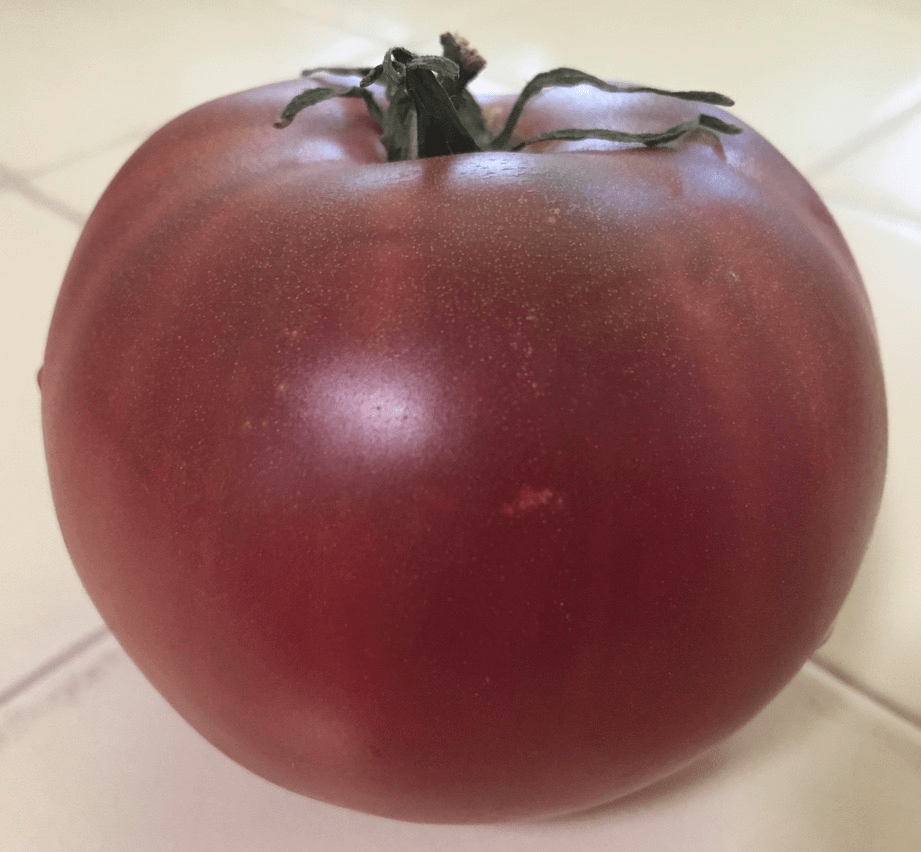
Summer tomatoes are gardeners’ gold, and last summer mine were a disappointment.  Soil, weather, whatever the reason, conditions were not conducive.  Only one plant produced decently, and a squirrel built his nest in the tree above the garden boxes and took most of the fruit as it ripened.  A nasty squirrel with a raw red patch on his neck- mange or some festering wound- he stayed away from the other squirrels in the backyard. He was gross and I wanted him gone.  I peppered the perimeter, covered the plants, left the dogs out; nothing kept him away.  I would have toppled the nest if it weren’t so high.  The last time I saw him I was shooting BBs at him as he ran down the fence rail.  

Chico is a northern California treasure.  Many of us grew up here exploring the parks and swimming holes, riding our bikes everywhere, hanging out downtown.  Many of us chose to raise families here so our own children could do the same.  Many of us are reluctant to let our kids do those things because an increasing homeless population is inhabiting the places we want to play.  So we voted for leadership and policies to move people out.  The thing is, over the years we’ve also voted for leadership and policies that removed the safety nets that could have kept folks off the streets and out of the parks to begin with.

We decry the choices of the homeless, but the choice to be unsheltered is akin to a tomato choosing to produce, and the reasons are myriad and complex. Sometimes we get hurt, or sick, or wildfire burns our trailer down, and there isn’t any insurance.  Sometimes mental illness, abuse,  addiction, render us without support and incapable of organized decisions.  Sometimes the soil we are planted in is depleted, and there are no resources left.  Often reasons overlap. I grew up with plenty of people in such circumstances.  If you grew up here, you did too.  Incidents of childhood trauma are higher in Butte County than anywhere else in the state, and over 20% of our population is living in poverty.  It’s not hard to see how quickly disaster can remove a precarious roof, and once gone it’s not so easy to replace with a different choice.

I miss my childhood Chico. The detritus of campers blight our parks and creeks.  There’s a tent on the beach at my favorite swimming hole. I’ve been verbally accosted a couple of times.  I’m uncomfortable letting my kid have the experiences that are the reason I moved back here in the first place.  But the humans inhabiting the streets are a whole lot more uncomfortable than I am, and the issue isn’t exclusive to Chico. Societal changes have largely stripped away access to humane lifestyle for those born to, or fallen upon, inhospitable conditions.  Where are people with nowhere to go supposed to go?  

It’s critical to remember the absolute humanity of people on the streets, and I hesitate with my analogy.  It’s just that I found I was relieved when after a brief hiatus my tomatoes were once more getting lifted.  I never saw him again, but I do hope it was the same squirrel.  He had enough hardship in his life- sick and alone- and I’m ashamed of the way I went after him with violence. I don’t know about next season when another squirrel inhabits that nest. I don’t have the answers.  I do know I will try again for tomatoes, and I’m thankful that I have a place to grow them.

Blog at WordPress.com.

Up ↑